Story
Businesses & industryWhere Shamokin Stayed
Directories and an 1885 map place hotels within Shamokin’s commercial streets. The Douty House fire of 1872 and a later hotel proposal show how loss and rebuilding shaped that landscape.

Historic business art
Related historic advertisement
Advertisements connected to this story or place.
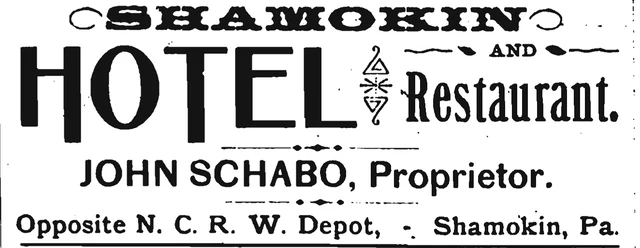
Hotel advertisement
Shamokin Hotel and Restaurant / John Schabo
Shamokin Hotel and Restaurant / John Schabo
Address: Opposite N. C. R. W. Depot, Shamokin, Pa.
A room, an address, and a proprietor
The 1884–85 volume names the City Hotel with George S. Fisher on Sunbury Street, the Eagle Hotel with Thomas F. Foltz at Market and Independence, and the Shamokin Hotel with John Schabo on Commerce. Those entries give a proprietor and place in one printed moment. They do not establish the full life of a building or every person who managed it.
Hotels inside the commercial city
Across the volumes, hotel listings sit among railroad employees, express agents, restaurants, saloons, merchants, and professional offices. That printed company helps explain the hotel's urban role without assigning an undocumented function to any one house. A traveler needed lodging, but residents also encountered hotels as workplaces, landmarks, dining places, and addresses used in everyday directions.
Placing hospitality with care
The 1885 historical map sheets and later printed addresses can narrow a hotel to a particular block, yet its precise site has not been established. Street numbers, names, owners, and building uses can change.
The Graemar Hotel Appears by 1908
A 1908 photograph identifies the Graemar Hotel. No confirmed listing appeared in the four earlier directory periods; its location remains uncertain.
The Windsor at Independence and Liberty
The Windsor Hotel is pictured with an eastward Independence Street view. An 1890s address and the 1907 mapped footprint agree at Independence and Liberty Streets.
The morning the Douty House burned
On April 15, 1872, a fire at the Douty House spread into surrounding homes and businesses. The Sunbury American’s April 20 account, reprinting the Shamokin Advertiser Extra, placed discovery at about four-thirty in the morning. Hundreds of men, women, and children reportedly gathered. With no fire engine to bring into service, people carried water in buckets, used axes, and pulled down small buildings in an effort to check the flames.
The account described destruction in the square bounded by Sunbury Street on the south, Dewart on the north, and Rock on the east, followed by fire crossing neighboring streets. The Douty House, its office, and stabling burned to the ground. Houses, smaller business buildings, and storage structures were also lost. Lodging stood within a dense working neighborhood; the fire did not stop at a hotel’s doors or affect only travelers.
Other buildings were threatened but saved. The paper named the Douty residence, the post office, and the Brown Stone Front among the places rescued with difficulty. The United States Hotel, owned and occupied by Jacob Mowry, caught fire several times but was not included among the buildings destroyed. That distinction matters in following the hotel landscape: a building endangered during a major fire did not necessarily disappear from the town.
A local disaster travels through the newspapers
News reached readers far beyond the coal region. The Chicago Tribune’s April 16 Fires column carried a special dispatch from Shamokin, relayed through New York. It reported the Douty House and nine adjoining houses destroyed, thirteen families homeless, and an estimated $120,000 loss. The later Sunbury American account reported fourteen buildings and fourteen families, with estimated losses ranging from $50,000 to $90,000. Both called the fire’s origin unknown. Their differing early figures record how the disaster was reported, rather than one settled final assessment.
The local account praised the people working against the flames and ended by urging residents to obtain a fire engine. Its appeal joined immediate destruction to a question of civic protection. For the people who had lost homes and belongings, the fire was more than the loss of a landmark. For Shamokin’s business streets, it exposed how closely dwellings, hotels, stables, and small establishments shared the same risk.
A hotel corridor and an unbuilt promise
Thirteen years later, the September 1885 Sanborn map placed several hotel names within the commercial blocks around Sunbury, Shamokin, Commerce, and Franklin Streets: City Hotel, National Hotel, Central Hotel, and a property labeled Curtis Ho.. Dining rooms, saloons, shops, storage, and dwellings surround the labels. The mapped names give a dated view of lodging woven into the city’s everyday business, without establishing that these buildings succeeded the Douty House or its neighbors.
A 1905 Herald souvenir edition looked back on early hotels along Shamokin and Sunbury Streets and linked Joseph Snyder and Jacob Dyer with the National Hotel building. It also looked forward, describing a proposed five-story hotel at the historic Lyndhurst site. The proposal belonged to the town’s ambitions at that moment. It should not be mistaken for a completed hotel or automatically identified with the later Windsor: remembered beginnings, mapped buildings, and plans for rebuilding tell different parts of the lodging story.
Image gallery
Open any image to view the full-size photograph or document.