Story
Electricity & inventionsMaking Machines in Shamokin
Mine lamps, breathing apparatus, heating equipment, protective electrical circuits, and garment steamers show how local technical work moved between workplaces, patent drawings, and the newspaper.
Historic business art
Related historic advertisement
Advertisements connected to this story or place.
Industrial advertisement
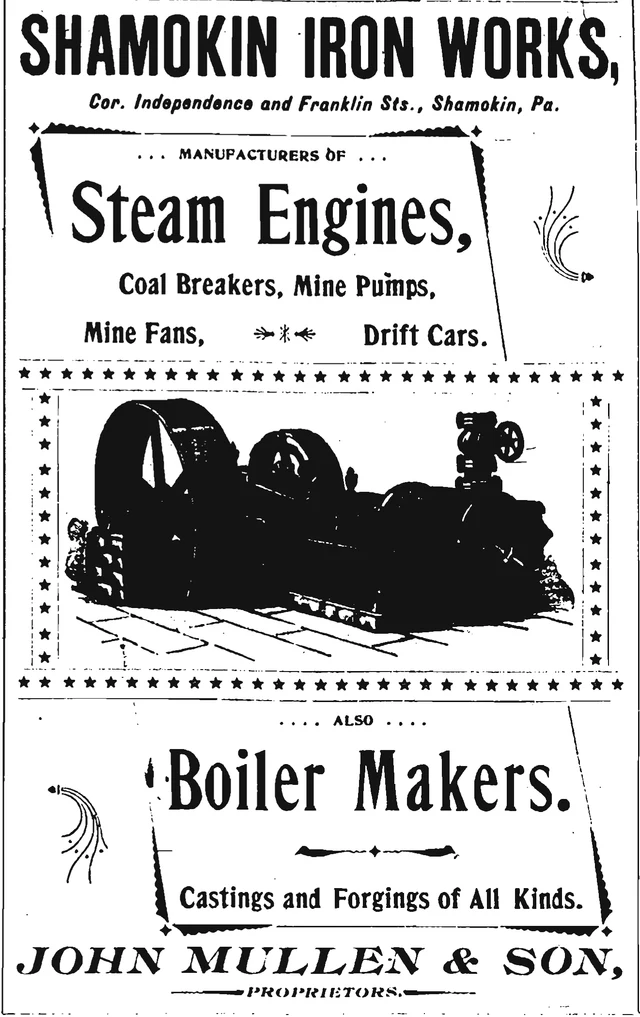
Shamokin Iron Works / John Mullen & Son
Shamokin Iron Works / John Mullen & Son
Address: Cor. Independence and Franklin Sts., Shamokin, Pa.
In 1871, the Sunbury Gazette credited Shamokin Iron Works with a 20-horsepower engine for the fan at Henry Clay Colliery. The engine placed local machine-making at the service of a working mine. Later newspaper stories would carry the names of individual inventors as well as firms, describing efforts to improve lamps, breathing equipment, heating, electrical protection, and the care of clothing.
A Lamp for a Moving Miner
Thomas A. Black of Shamokin received U.S. Patent 944,171 for a miner’s lamp on December 21, 1909. His design addressed a small but consequential problem in an oil lamp worn on a cap: as the wearer stooped or moved suddenly, oil could escape through the lamp’s ventilation opening. Black described both wasted fuel and the danger created when oil sloshed into a vent and interfered with the lamp’s draft.
The patent drawing placed a curved, coiled ventilation tube at the rear of the lamp. Its coil was intended to retain oil that entered the tube, allowing it to drain back into the lamp rather than spill out. The tube also joined the lamp body to its supporting hook, serving as a brace. This was an improvement to a particular piece of miners’ equipment, shaped around the movements of the person wearing it.
William Giles and the Mill Shop
William T. Giles’s 1958 obituary remembered a career spanning mines, railway work, and textile machinery. It said he moved to Shamokin in 1881, worked in mining, became a steam-engine locomotive workman for the Reading Company, and later worked as a machinist at the J. H. and C. K. Eagle silk mill. The obituary also credited him as co-inventor of an air-conditioning unit installed at the Shamokin mill.
Giles later established a knitting mill of his own. The obituary reported that it employed 85 people for a time before being discontinued in 1920, and that he retired in 1950 at age 82. His remembered working life crossed several of the region’s industries: the mine, the railway shop, the silk mill, and a manufacturing business of his own.
Heating Equipment and a Sunbury Factory
In August 1937, the Shamokin News-Dispatch described V. M. Cruikshank as a Shamokin inventor whose heating equipment was being manufactured in Sunbury. The product was known as the “Imp.” According to the report, its existing factory occupied a three-story building that had become inadequate for production, and Cruikshank had purchased the former Pennsylvania Railroad shops in Sunbury. The deed was reported to have passed that morning.
The name appeared beyond the local newspaper. An Anthracite Industries equipment advertisement in the July 1938 American Builder listed the IMP under burner-boiler units, with V. M. Cruikshank Utilities at 18 South Seventh Street, Sunbury. The Beacon Boiler Reference Book listed seven models of IMP automatic stokerless boilers. These trade entries give the newspaper’s short factory announcement a more tangible companion: a company address, a product category, and a range of model names.
Louis Poliniak’s Hydrespirator
Louis Poliniak, a Reading Railroad trackwalker from Shamokin, was the subject of a brief in the Daily Item on August 7, 1937. He told the paper that he had conceived his “hydrespirator” 16 years earlier and had begun work in earnest during the preceding year. The newspaper described it as a gas-mask device using liquid chemicals and printed his claim that it could remove impurities from air.
Poliniak’s patent had been issued four days before that report. Its drawings showed a liquid tank carried on the wearer’s body and connected by a flexible tube to a mouthpiece. In the design, inhaled air passed down through water or another liquid before reaching the wearer, while exhaled air left through a check valve. The patent’s stated purpose was to remove dust, fumes, and foreign matter from the air; it described an intended protective device, not a demonstrated ability to remove every contaminant.
An Inventor in Wartime News
In August 1942, Richard J. Heintzman told the Daily Item that the War Department had accepted a new device he called a secret weapon and retained its model. The brief also associated him with a safety blasting plug. Almost everything about the new device remained behind the newspaper’s headline: its design was not described, and the account of official interest came from Heintzman himself.
Peter Sosnoski’s Protective Circuits
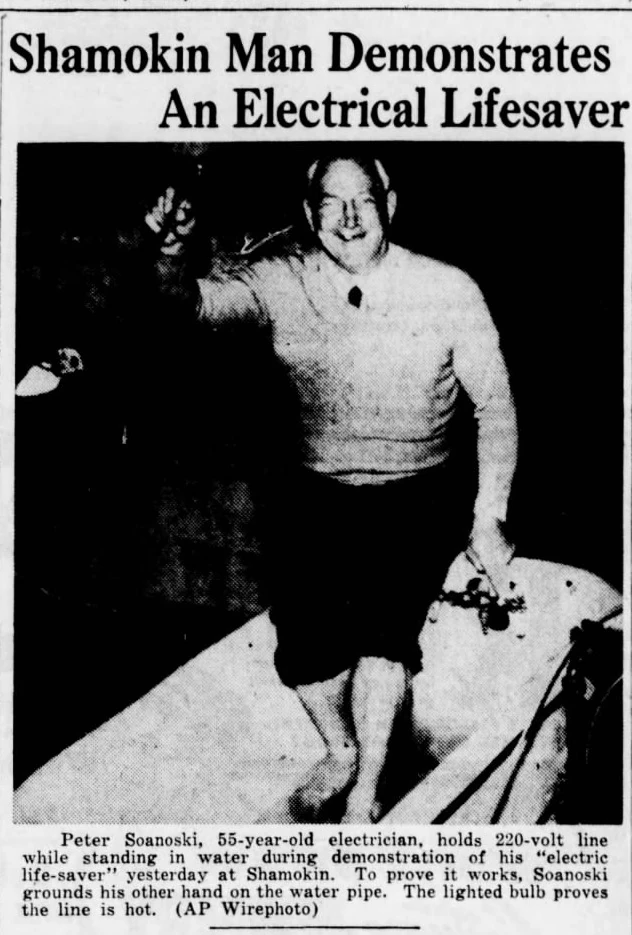
Peter A. Sosnoski brought his Electrical Lifesaver before invited guests at a Shamokin demonstration in 1954. A photograph and Associated Press report appeared in Hazleton’s Standard Sentinel, carrying the local electrician’s demonstration to a wider audience. The device was presented as a means of interrupting current when an electrical system became grounded.
The patent record follows that work over more than a decade. Sosnoski’s Protective Circuitry patent, issued July 22, 1958, identified him as a Shamokin inventor and referred back to an Electric Lifesaver application filed in April 1954. It described relays arranged to interrupt the electrical supply when grounding occurred. A Small Current Flow Relay Switch patent followed on October 5, 1965, explicitly intended for use with the earlier protective circuitry.
Sosnoski’s Ground Fault Protective Circuitry patent was issued on November 22, 1966. It again developed his earlier work, describing a system intended to limit current from a grounded line and interrupt the supply. His 1967 obituary remembered him as an electrical engineer, contractor, and founder of the S. O. S. Electric Company, and said that he had worked as a planner and estimator at the Philadelphia Navy Yard during both world wars. The patents make his continuing technical work visible; the obituary preserves the broader career his community remembered.
Two Garment-Steamers and a Patent Suit
Garment care brought another set of patents into the Shamokin story. U.S. Patent 3,436,851, issued April 8, 1969, named Jack J. Gilbert of Spring Valley, New York, as inventor and Bernard Frank of Shamokin as assignee. Its hand-held electric steaming and pressing device was intended to touch up hanging garments. The design combined an electrically heated water tank, a handle, and a steam-emitting pressing plate.
A separate Portable Clothes Steamer patent was issued to Bernard Frank on December 23, 1969, with Franzus Industries of Shamokin named as assignee. Frank’s design used internal baffles to give steam a zigzag path from the heated water chamber to the garment head. The arrangement was intended to return droplets to the water chamber and reduce spilling and sputtering as the hand-held appliance was moved.
That same December, the News-Item reported that Franzus Industries, whose principal place of business was listed at 214 East Independence Street, had filed a patent-infringement suit in the Eastern District of New York. The report concerned Gilbert’s April patent and described Franzus’s complaint about competing steaming and pressing devices. It was an account of allegations at the start of a court action, not a ruling on the dispute. By then, local invention had entered a world of product names, patent assignments, advertising, and litigation as well as workshop drawings.