Story
Fires, disasters & public safetyThe Victoria’s Return After the Fire
After the December 1916 fire, insurance decisions, property purchases, construction contracts, and an opening-night advertisement trace the Victoria’s return in January 1918.
A Theater in a Burned District
The Victoria’s reopening began with a district in ruins. In December 1916, newspapers followed a Shamokin fire that damaged homes, businesses, and the theater. The Mount Carmel Item’s December 18 aftermath report described two burned blocks, still-smoldering wreckage, and visitors making their way through the streets to see the damage. It said the Victoria’s stone front and entrance remained standing while the rest of the theater had burned. The familiar name survived, but an evening’s entertainment could not simply resume behind it.
Rebuilding depended on matters less dramatic than the fire itself. A Morning Press report published December 21, datelined Shamokin the previous day, said property owners were waiting for insurance inspections and arrangements for settling claims before making definite plans. The same item described contributions for displaced families and expected the relief fund to pass $5,000. It anticipated substantial new buildings within a year. That was a hopeful forecast, while inspections, settlements, and decisions still lay ahead.
Two Corners, Separate Plans
On January 8, 1917, the Mount Carmel Item reported an important purchase by the Chamberlain Amusement Corporation: the Market House property at the northwest corner of Independence and Anthracite Streets. The article gave its frontage as 76 feet on Independence and 200 feet on Anthracite. It said the company intended both to rebuild the Victoria and to erect another theater on the newly acquired site. The purchase report thus described more than one proposed theater, not a single settled plan for every nearby parcel.
Across the intersection, George J. Higgins and his son John had bought the Croninger property at the southwest corner. Their separate proposal called for a theater, with William Lee named as architect. A March 15 report said Higgins’s plans were complete and bids would be opened March 24. It described a theater on the first floor, offices above, and a third-floor dance hall. This was another project in the same rebuilding district, not an alternative name for Chamberlain’s Victoria.
A Contract Before the Curtain
By June, the Victoria was the subject of a construction notice. The Morning Press reported on June 29 that Frank P. Edwards had been awarded the electrical-wiring contract for the new theater. It added that he also held a wiring contract for an adjoining theater, without naming that building. The notice records an award, not finished wiring. It gave a projected seating capacity of 1,600, an important difference from the 2,500 seats advertised when opening approached.
Selling the New Victoria
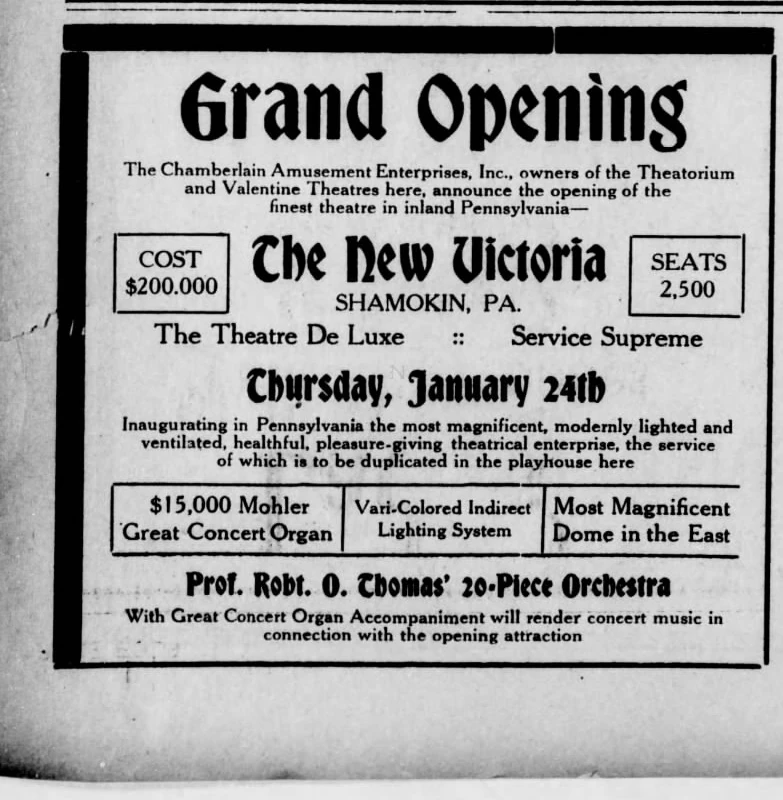
The January 1918 opening campaign presented a theater meant to impress. On January 22, the Mount Carmel Item announced Thursday’s formal opening and described leather-upholstered seats, a large decorated dome, indirect lighting in twelve hues, and a concert organ. It reported a cost exceeding $200,000 and a capacity of 2,500. These were the figures and features offered in opening publicity; the earlier construction notice’s smaller capacity remains a reminder that published descriptions need not agree.
The following day’s display advertisement put the name of the New Victoria between bold statements of cost and seating. It announced January 24 and promised concert music by Professor Robert O. Thomas’s twenty-piece orchestra with organ accompaniment. Lighting and the dome received their own boxes in the advertisement. The invitation sold more than a screen: it offered music and an elaborate interior as part of the opening attraction. The concert organ’s $15,000 value was another advertised claim, rather than a surviving purchase account.
The Morning Press carried a parallel advance account for Bloomsburg readers. General manager L. J. Chamberlain promised the same entertainment service at the company’s Bloomsburg Victoria as at the new Shamokin playhouse. The statement places the opening within a business that was addressing audiences in more than one town. It is a promise about the programs to come, not a record proving that every house later presented identical entertainment.
The Opening Report
A brief in Pottsville’s Republican and Herald on January 26 supplied the next step: the Victoria had opened at Shamokin on Thursday, January 24. It repeated the $200,000 cost, 2,500-seat capacity, and $15,000 organ figures. The opening statement is distinct from the advance advertisements, even though the repeated numbers were not independently audited. After more than a year of damage reports, waiting, purchases, and contracts, the theater was again reported open.
The contrast between the ruined district and the opening advertisement gives this story its shape. One December report recorded a surviving entrance and a burned interior; the January publicity invited patrons into a playhouse with music, decorative light, and upholstered seats. Between those moments stood the work of deciding, financing, contracting, and preparing. The reopening returned the Victoria’s name to the city’s entertainment life, while the newspaper trail preserves both the ambition of the new theater and the uncertain details behind its advertising.