Story
Community & everyday lifeShamokin Through Time
Move through nearly two centuries of Shamokin history, from the 1835 town plan and the railroad strike of 1877 to electric light, industrial change, landmark loss, and recent recovery.
Some details remain uncertain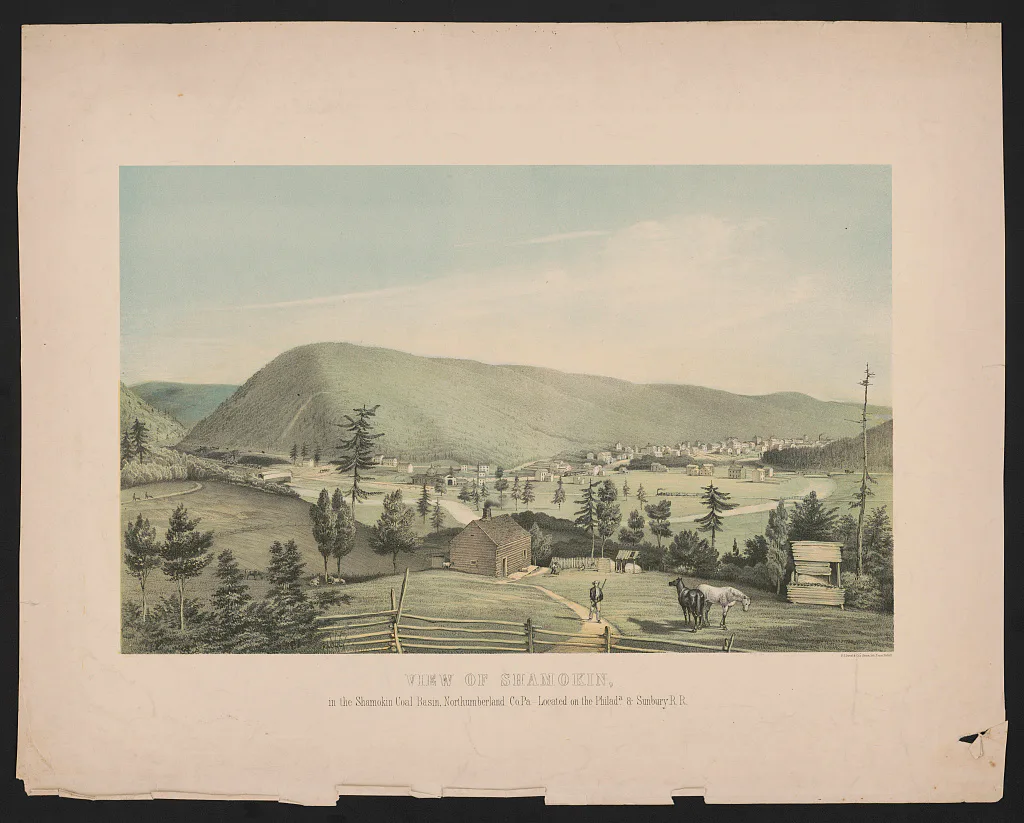
A City Measured in Turning Points
Shamokin’s chronology begins with the modern town plan in 1835 and follows events that changed how residents worked, traveled, worshiped, gathered, and governed themselves.
Industry, Invention, and Community
Railroads and anthracite shaped nineteenth-century growth. Electric service began in 1883, the Ukrainian National Association traces its origins to an 1894 Shamokin meeting, and later factories, newspapers, parks, and institutions added new layers to the city.
Loss and Renewal
Fires, demolitions, economic change, and municipal distress altered familiar places. The adoption of a revitalization plan in 2020 and the end of Act 47 status in 2024 belong to the same continuing story of adaptation.
- The modern town is laid out
The date marks the layout of the modern town; people lived in the region long before 1835.
- James Fuller Queen draws Shamokin from Mount Carmel Road
Queen made more than one Shamokin view in 1851; this drawing looks from Mount Carmel Road.
- James Fuller Queen draws Shamokin Creek in a shower
This rain-swept creek view is a separate work from Queen’s road drawing and the later Duval print.
- P. S. Duval & Co. prints a color view of Shamokin
Duval’s color print offers another view of the growing rail and coal town, distinct from Queen’s two drawings.
- Shamokin is incorporated as a borough
Records establish borough incorporation in 1864, although the exact November day has not been confirmed.
- Uprising during the Great Railroad Strike
An 1891 account reported fourteen wounded; a later local history reported two deaths and about twelve wounded.
- Local investors contract for an Edison central station
The May agreement documents the planned central station and distribution system without confirming every detail repeated in later accounts.
- Shamokin's Edison station begins service
The new system reached businesses, homes, and St. Edward’s, an important early church installation whose exact national ranking is debated.
- The organization now known as the UNA is founded in Shamokin
Founded as the Ruthenian National Association, the organization adopted the Ukrainian National Association name in 1914.
- Edgewood Park is operating by 1905
A dated postcard proves that visitors knew Edgewood Park by 1905; its exact opening and closing dates are still uncertain.
- National Ticket grows, burns, and rebuilds
The range gathers several turning points: publishing work, incorporation, plant construction, the 1942 fire, and postwar rebuilding.
- Victoria Theatre is built, opens, and is later demolished
The theater opened in 1918. Surviving secondary accounts place demolition in 1998 or 1999, and a definitive permit has not yet settled the year.
- Shamokin transitions to third-class city government
Shamokin became a city in 1949, with third-class city government taking effect in January 1950.
- Fire destroys historic St. Edward's Church
Local records date the fire that destroyed the historic church to April 8, 1971.
- Doodle Bug Park opens
The family amusement park opened on June 22, 1958, and remained part of area summers through 1976.
- City Council adopts the GoShamokin plan
Council adoption started a continuing period of downtown implementation rather than a single finished project.
- Pennsylvania ends Shamokin's Act 47 status
The state order marked legal financial recovery while revitalization and redevelopment work continued.
Image gallery
Open any image to view the full-size photograph or document.