Story
Businesses & industryCommerce Beyond the Shop Counter
Factory plans, shoe repairs, brewery deliveries, theater programs, and an Elysburg warehouse fire reveal the work behind the region’s commercial life.
A town’s commerce was more than what stood in a shop window. It included flour milling, hopes for new factories, the repair of worn shoes, brewery deliveries, and the sale of an evening at the theater. Newspaper notices bring these different kinds of work together, from the ordinary movement of stock to the sudden loss of an entire business building.
Plans for Mills and Factories
In September 1883, the Sunbury News reported that Andrew Robertson, proprietor of Shamokin’s existing flour mill, intended to build a new mill three stories high and measuring 50 by 40 feet. He planned to turn the old mill building into storerooms. It was a compact announcement of an ambitious rearrangement: new space for milling, with the familiar building put to another use.
A notice in the Lebanon Daily News in November 1890 described another proposed addition to Shamokin industry. William Forry, of I. W. Forry & Son, hosiery manufacturers in Myerstown, was to superintend the erection of a factory at Shamokin. The brief announced an intended project, rather than an operating mill. Both notices capture the town as a place where businesspeople imagined room for further industry.
Keeping Shoes in Service
Frank Posca’s Central Shoe Repairing Shop appeared in the Shamokin Dispatch’s 1927 “Who’s Who in Shamokin and Vicinity” pages. Its address was 320 Shamokin Street. The profile looked back to an earlier shop at 413 Shamokin Street and said Posca had been working at the newer address for the past three years. The move was presented as a response to a growing trade and the need for more room.
The promotional profile emphasized electrical machinery, leather, and Goodyear-welt shoe repairs. It also displayed the language of a business seeking customers: guarantees of satisfaction, praise for the proprietor, and claims of a trade reaching surrounding towns. Behind that salesmanship was a practical service. Repairing shoes kept something already owned in use, connecting a small workshop on Shamokin Street with the daily needs of its customers.
The Brewery’s Wider Circle
Fuhrmann & Schmidt’s 1939 newspaper publicity presented the brewery as part of a much wider local economy. Alongside a photograph of its East End plant, a large company advertisement pictured officers, a brewmaster, engineers, bottling and shipping workers, and distributors. The company emphasized its use of anthracite, its local purchasing, and the circulation of employees’ wages in Shamokin. These were the brewery’s own claims about its importance, but the portraits also show how it wanted the public to see the many people behind a familiar product.
Stock, Tickets, and an Evening Out
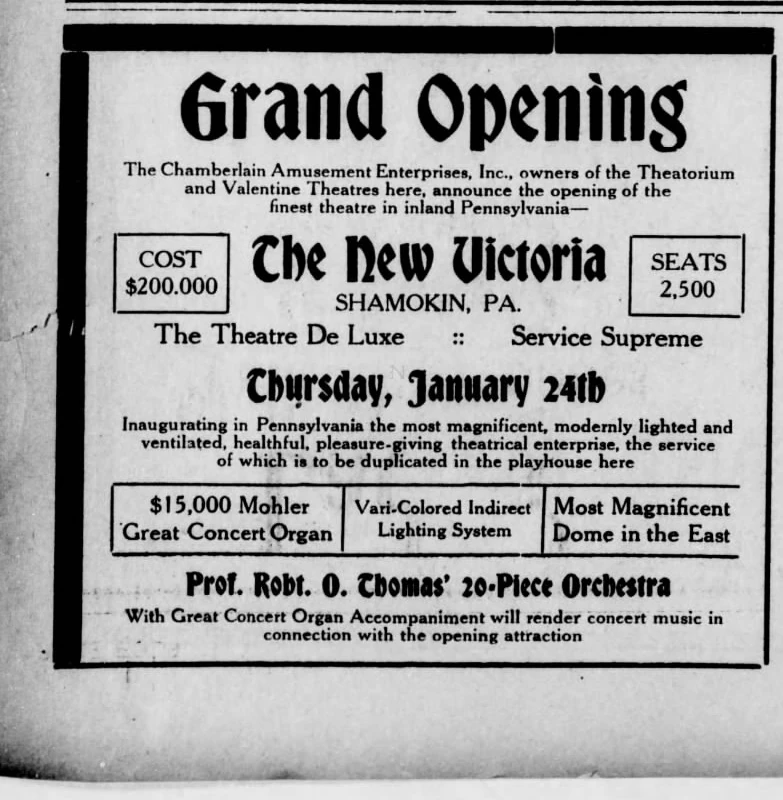
Shamokin’s commercial life also included the sale of an evening out. For the Victoria’s January 24, 1918 opening, publicity offered an organ, an orchestra, and lighting as part of the attraction. The theater was selling a setting and a program as well as a ticket.
A store’s closing produced a different kind of transaction. In 1937, C. C. Leader’s stock went to Wolfe, according to a newspaper account. Merchandise could pass from one business to another, continuing its commercial life after the store that had stocked it discontinued operations.
In 1944, the Victoria advertised five shows of Around the World. The names of the film’s performers helped sell the screen attraction. For a customer choosing a show, the advertisement joined a familiar local theater with entertainment made far beyond Shamokin.
A Delivery Business Lost to Fire
On February 28, 1964, fire destroyed the Persing Brothers building in nearby Elysburg. Although the headline called it a potato-chip plant, owner Walter Persing told the newspaper that the company did not produce potato chips. It distributed packaged chips and other goods. The building held merchandise, packing material, and a delivery truck; the report said it had once been a barn and had been remodeled for the business.
Employee Mary Zimmerman was reported to have discovered the fire at about 11:30 that morning and raised the alarm through an intercom to the Persing home. Persing attempted to fight the flames and get the truck out, while his wife called the fire company. The newspaper’s tentative loss estimate was $50,000. In a single morning, the ordinary apparatus of regional delivery—stock, containers, a building, and a truck—had become a scene of ruins.