Historic Place
Eagle Silk Mill
The Eagle name appears on several Shamokin-area silk facilities. Dated maps distinguish their buildings and work areas, while a surviving bell and eagle carry part of that industrial story into public remembrance.
Work Inside the Mill
The Eagle Silk Mill study documents the Shamokin mill as part of the Eagle company's regional textile enterprise.
A Landmark on the Sanborn Maps
The 1913 Sanborn map set places the mill within Shamokin’s industrial landscape during that era.
What Remains Today
Accounts disagree on the mill’s exact size, but surviving maps and records show that it was one of Shamokin’s major industrial complexes.
More Than One Eagle Site
The Eagle name belonged to more than one mapped industrial site. A July 1913 Sanborn sheet labels J. H. & C. K. Eagle Silk Mill No. 1 in the Coal Township area near Eagle Avenue and West Arch Street. An office, dye house, and silk-mill building appear within that setting. The map establishes a numbered facility there by 1913; it does not date its construction. That distinction matters when a later account gives a 1917 date for an Eagle building elsewhere.
The February 1922 maps make the differences clearer. Sheet 28 names the Silk Edgewood Mill near North Ash Street, Eagle Avenue, and West Arch Street. Its labeled departments include storage of finished material, inspecting and shipping, dye houses, an office, a laboratory, chemical storage, drying, and finishing. Those room names reveal different kinds of work within the complex, rather than a single undifferentiated factory floor.
Elsewhere, sheet 5 depicts the Industrial Mill and a separate Throwing Mill in the north-side rail corridor. It also labels a conditioning room. Sheet 6 shows an Eagle complex beside Coal Creek, including a power house, machine-shop and carpenter functions, and storage. These are separate locations within the same map edition. Their shared Eagle labels are a reason to study their connections, not a reason to combine all of their buildings into one site.
The Power Behind the Work
The July 1929 maps continue the Industrial and Throwing Mill names and add a direct link between facilities. The note on sheet 5 says their power and light came from a private power house shown on sheet 13. Turning to that sheet brings the reader to Coal Creek, an Eagle dye-house and silk-mills setting, and a separately labeled Eagle power house with an engine room. The cross-reference connects industrial work to support machinery elsewhere in the city.
Later planning records speak about former mill land in a different way. The 2020 Brownfields inventory identifies a former Eagle silk-mill site on Water Street, parcel 010-02-002-209, and describes it as vacant at that time. A separate preliminary community plan reports a building constructed in 1917, used by businesses including Arrow Shirts through 1972, and demolished in 1997. These are the planning documents’ accounts. Without matching their parcels to the historic map footprints, those dates cannot safely be assigned to every Eagle facility.
A Bell in Public Memory
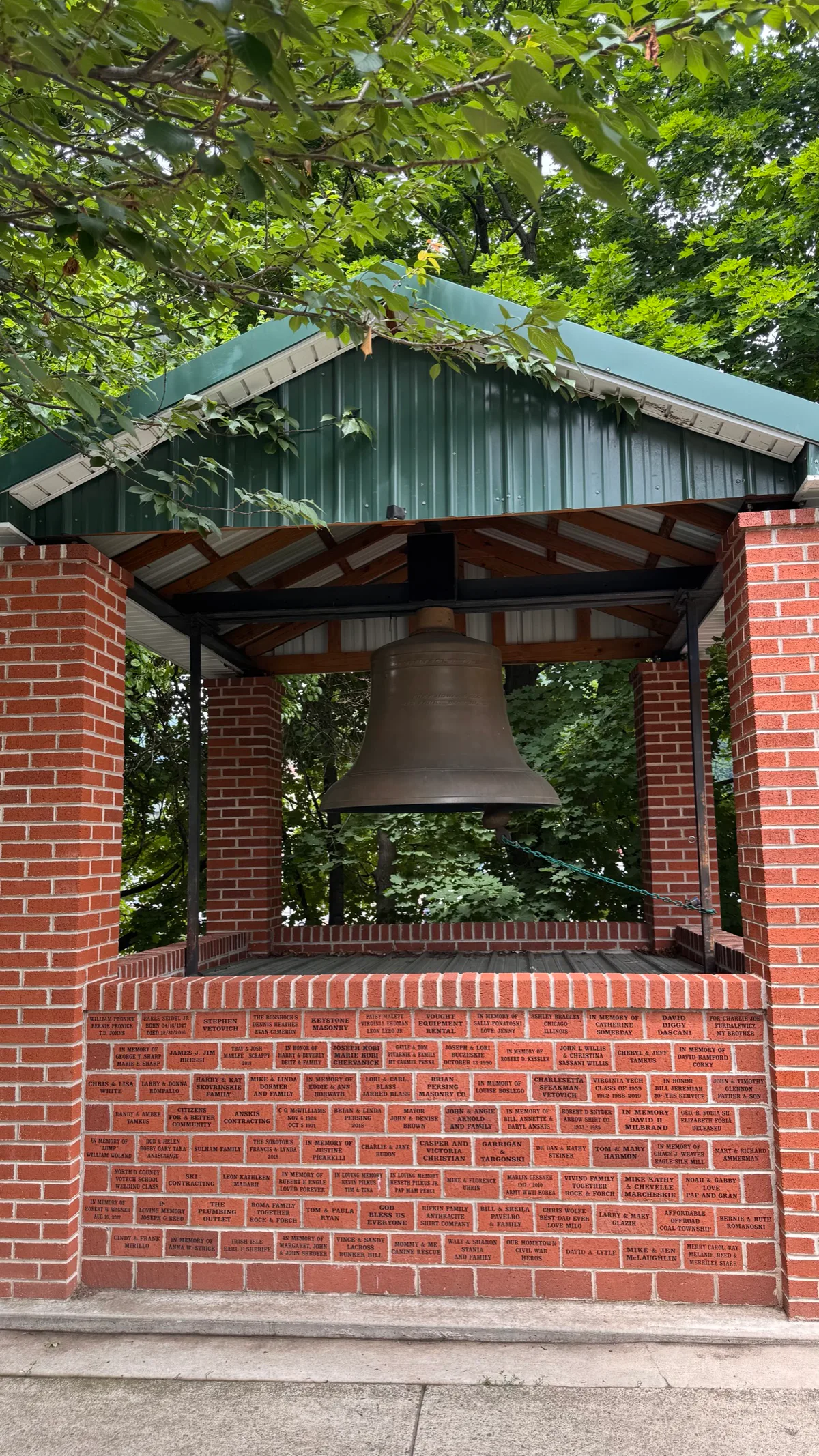
Remembrance continued after the industrial uses. On March 12, 2018, Shamokin City Council authorized Citizens for a Better Community to place the former mill bell on Lincoln Street. The minutes also record discussion of Mill Square as another possible location. That vote documents an authorization, not the day the bell was installed.
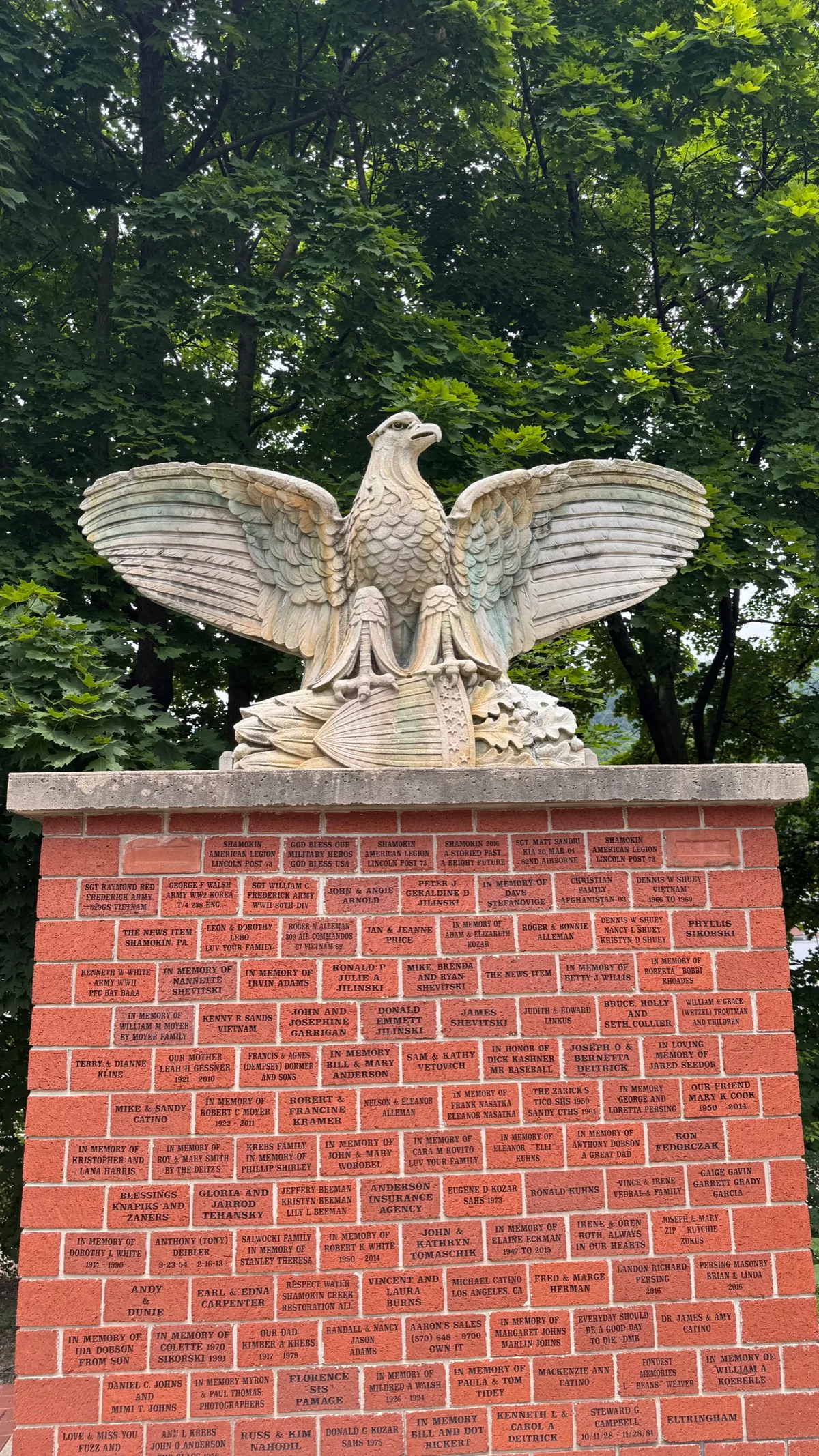
The Historical Marker Database later credited William Fischer, Jr. with photographs dated September 13, 2023 of an Eagle mill marker, decorative eagle, and bell at Lincoln and Anthracite Streets. That attributed photo record helps carry the story from a proposed placement to objects documented in public view. It does not settle the bell’s earlier custody or the separate demolition dates found in later accounts. The surviving objects and the maps preserve different parts of the same industrial memory: physical reminders on one hand, and the distinct workplaces behind the Eagle name on the other.
Image gallery
Open any image to view the full-size photograph or document.