Story
Electricity & inventionsBuilding Shamokin’s Telephone Connections
Shamokin’s telephone network grew through wires, operators and regional exchanges—from the first equipment to dial service.
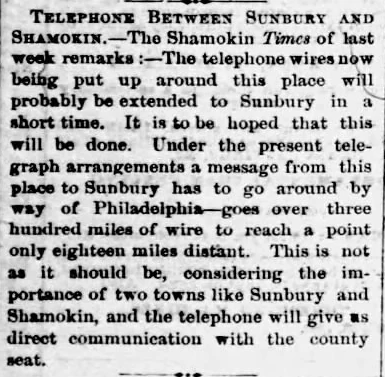
A shorter route to Sunbury
In November 1880, a local account described telephone wires going up and expressed hope for a connection with Sunbury. It contrasted that possibility with a cumbersome telegraph route through Philadelphia. For callers, the promise was not technology in the abstract: it was a more direct way to reach a nearby town.
The comparison made the inconvenience vivid. Although Sunbury was only eighteen miles away, the account said a telegraph message could travel over three hundred miles of wire by way of Philadelphia. Telephone wires were going up around Shamokin, and the writer hoped they would soon reach the county seat. The connection was still a prospect, but its value was easy to imagine.
Sunbury was considering its own exchange that November. A separate brief said organization was under way and that instruments were expected to cost about four dollars a month if the project received enough encouragement. In December, papers reported completed wires between Sunbury and Milton, with communication expected shortly and a telephone being installed in the prothonotary’s office. These were regional steps toward a network, not proof that every proposed town-to-town conversation was already possible.
People at the call board
A later retirement profile of Raup recalled the human work behind the network. It placed him among the people unloading equipment in January 1880 and described duties that ranged from operating to troubleshooting and management. Telephone service depended on people who could keep a connection working as well as on wires overhead.
The profile appeared when K. C. Raup retired in 1926 after forty-six years with the telephone company. It recalled that he had helped unload Shamokin’s exchange equipment in January 1880 and then worked at the call board. By the time of his retirement he had long been general manager of the Williamsport district; the local recollection linked that larger career to the practical work of establishing service here.
A centennial history published in 1964 filled out the early office’s routine. It described Raup as operator, janitor, fireman, collector and bookkeeper, sometimes leaving the switchboard to perform another duty and interrupting service in the process. The telephone was an electrical invention, but a caller still depended on someone being at the board to make a connection.
Both the retirement profile and the centennial history placed Ella Brock’s arrival as an operator in 1883. The later account called her Shamokin’s first woman telephone operator. Her arrival allowed Raup to concentrate on the company’s business affairs.
More customers, more connections
The 1964 history recalled eighteen customers with twenty-one telephones in 1881. It also described a Williams switchboard placed in service in 1884 and annual rates of thirty-six dollars for residences and forty-eight dollars for businesses. Those details sketch a small paid service rather than a telephone in every home.
That history traced extensions to Pottsville and Reading in 1884 and placed completed lines to Sunbury and Mount Carmel in 1893. The early hope for nearby connections had developed into a wider system, though the dates in this retrospective should not be confused with the first wires or first office equipment.
Other companies were building service in the region as well. On July 28, 1896, the Mount Carmel Daily News reported that the Shamokin Valley Telephone Company’s Sunbury exchange had opened the previous Monday. About twenty-five telephones were connected, with others being added. This is a separate company and a later exchange, not another name or opening date for Shamokin’s first Bell-related office.
From operators to dial service
The centennial account recorded two later changes in the way subscribers placed calls: conversion to dial service on September 27, 1952, and all-number calling on July 17, 1960. Its accompanying photographs showed earlier telephone equipment and service trucks, reminders that construction and maintenance continued behind each change at the subscriber’s end.
The opening year, 1880, is more secure than a single opening day: later accounts described October and December milestones differently. Across those beginnings and later conversions, the telephone’s usefulness rested on continuing effort—equipment arriving, wires going up, calls being handled and faults being repaired.
Brock’s Plan for Connecting Callers
A patent places Shamokin within the design work behind telephone exchanges. On August 7, 1883, the United States Patent Office issued Patent 282,699 to William M. Brock of Shamokin for Telephone Central-Office Apparatus. Brock had filed the application on November 14, 1882, and assigned a half interest to William H. Douty, also of Shamokin. The printed specification and drawing sheets give the surname as Brock, even though the later automated patent catalog includes the variant Brook.
His concern was the connection between callers. The specification proposed an annunciator, switchboard, and transfer table arranged so that two subscribers could speak without interfering with other lines. An annunciator was the signaling part of the apparatus: a numbered target could drop to tell the operator that a subscriber was calling. The patent’s first drawing showed a board with forty-eight such signals. It was a plan for handling many individual connections, not a claim that Shamokin already had that exact number of customers.
The proposed system still depended on an operator. The description follows the attendant answering a call, learning which subscriber was wanted, signaling that person, and making the connection. Indicators showed when a connecting line was in use. For larger arrangements, transfer tables allowed operators at different boards to signal one another and complete a connection across the system. One illustration used six boards as an example; Brock also described extending that arrangement.
Those details put familiar telephone work into mechanical form. A call had to be noticed, answered, directed, and kept separate from other conversations. Brock’s drawings and written explanation show how a Shamokin inventor proposed to organize those steps. The patent records that proposal and its grant, but does not prove that the apparatus was manufactured, installed in the local exchange, or commercially successful. Its place in the story is specific: a documented design for the work behind a telephone connection.