Biography
Holden C. Richardson
Shamokin-born Holden Chester Richardson united naval engineering with flight: designing seaplane floats and flying-boat hulls, developing aircraft-launching equipment, and piloting NC-3 during the Navy’s 1919 Atlantic expedition.

Holden Chester Richardson helped make an airplane at home on the sea. The Shamokin-born officer worked on the floats that supported seaplanes, the hulls of flying boats, and catapults that launched aircraft from warships. He also flew the machines whose construction he understood. In 1919, aboard the NC-3, engineering and seamanship became matters of survival when an Atlantic expedition ended his aircraft's journey in the water.
A beginning in Shamokin
Richardson was born in Shamokin on December 7, 1878. Local historical research identifies his parents as William A. Richardson and Elmira Jane Douty, and his maternal grandfather as Richard B. Douty, Shamokin's first chief burgess.
An account preserved by local historian One Point in Time recalls a boy fascinated by flight. In a 1928 reminiscence, educator Charles E. Beury remembered Richardson experimenting with kites on the Cameron culm bank. The same research places his graduation from Shamokin High School in 1896.
Shamokin remained part of his public identity. A Washington newspaper's 1929 career survey singled out the hometown airfield named in his honor and his flight there for its dedication the previous year.
Annapolis, study, and the football field
Richardson graduated from the United States Naval Academy in 1901 and earned a master's degree at the Massachusetts Institute of Technology in 1907. His Academy years also left a less formal record: a team photograph in the 1898 Lucky Bag names Richardson among the Hustler football players.
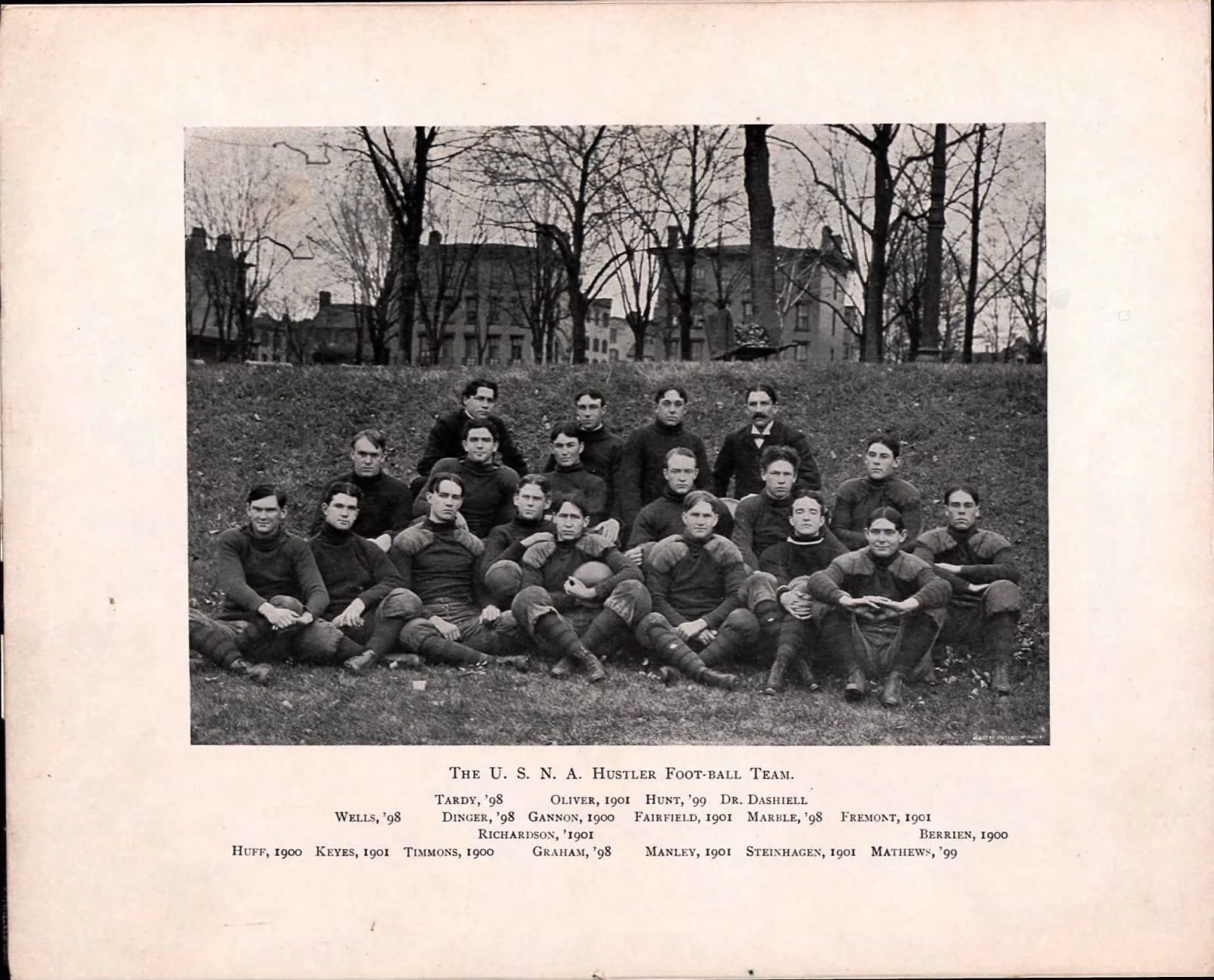
Richardson's “1901” in the photograph's caption identifies his class, not the picture's date. The following page describes the Hustlers' 1897 season and lists him again. Photograph and roster document his place in Academy athletics without a guess about where he sits.
Designing for water as well as air
For a seaplane, getting into the air begins with moving through water. Floats support the aircraft as it gathers speed; a flying boat's hull also carries the crew. Too much resistance can prevent takeoff.
Richardson studied that problem at the Washington Navy Yard's Experimental Model Basin. Tests compared float shapes at different speeds and angles. A step in the underside helped a float rise and skim across the water with less drag. Engineers could measure the improvement before committing a full-sized aircraft to the sea.
In 1912 Richardson translated Gustave Eiffel's aeronautical research into English. With David W. Taylor and William McEntee, he helped design the Navy's experimental wind tunnel. Basin and wind tunnel addressed the two halves of a flying boat's life.
The National Aviation Hall of Fame identifies Richardson as Naval Aviator No. 13 and the Navy's first engineering test pilot: a designer who also flew. He was formally designated a naval aviator in 1915.
Taking aircraft to sea
Catapults addressed another obstacle: a warship lacked an airfield's long runway. A launching mechanism accelerated an aircraft into flight from a much shorter space, helping connect naval aircraft to the ships from which they operated.
The Evening Star's 1929 retirement profile described him as a catapult developer and an authority on floats and hulls. It recalled his glider experiments and the early Navy-designed seaplane built at Washington. The Hall of Fame credits him with helping develop the first successful catapult—a collaborative achievement, not the work of a lone inventor.
A secretary at the beginning of NACA
Richardson served as the first secretary of the National Advisory Committee for Aeronautics, or NACA. Congress created the committee on March 3, 1915. Its first meeting took place on April 23 in the Office of the Secretary of War in Washington.
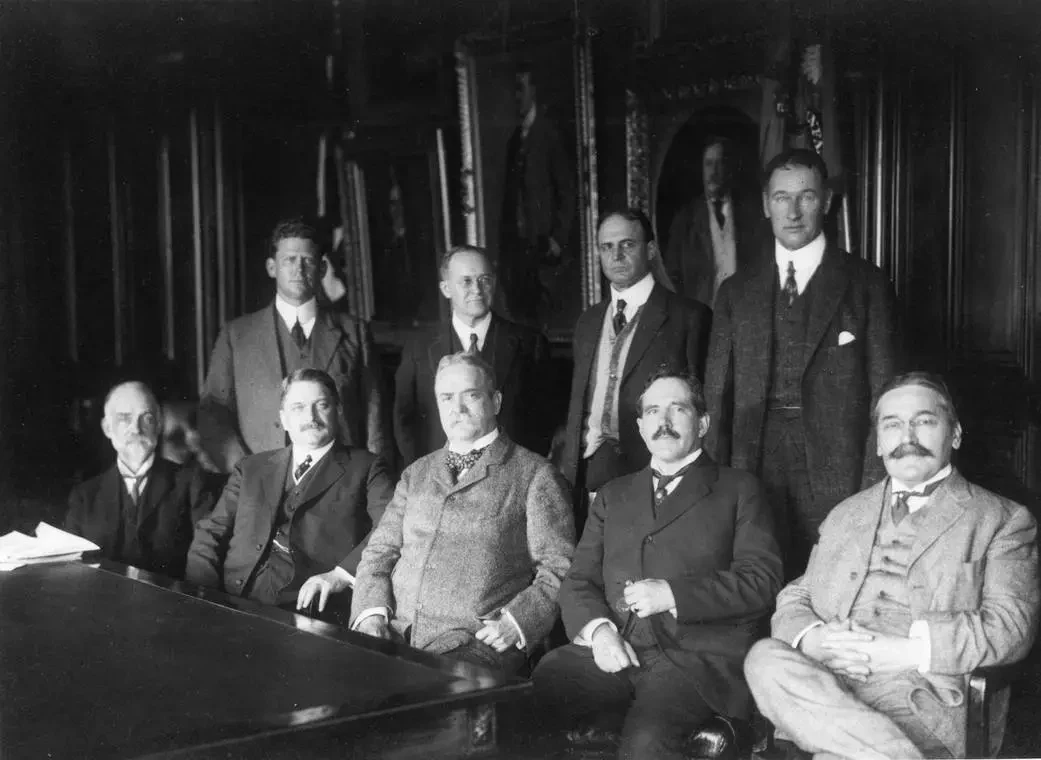
NACA went on to build laboratories and undertake aviation research. NASA incorporated its facilities and staff in 1958, carrying forward the work of the older organization Richardson had helped shape.
The Navy-Curtiss flying boats
The NC aircraft grew out of wartime needs. The Navy wanted large flying boats for long-range ocean operations. Their initials joined the Navy and Curtiss, the aircraft company involved in building them.
Richardson brought his knowledge of hulls and floats to a team including Taylor, Jerome Hunsaker, George Westervelt, and Glenn Curtiss. Strength, seaworthiness, range, and heavily loaded takeoffs all mattered. The hull was central to the aircraft's usefulness, not an incidental attachment.
On October 4, 1918, Richardson flew NC-1 on its first test flight. The end of World War I changed the program's immediate purpose. The Navy continued developing the flying boats and prepared an Atlantic expedition, taking the collaborative engineering effort far beyond the model basin.
NC-3's ordeal—and NC-4's crossing
On May 8, 1919, NC-1, NC-3, and NC-4 departed Rockaway, New York. Their route led through Nova Scotia and Newfoundland toward the Azores, Portugal, and England. Commander John H. Towers led the expedition; Richardson was a pilot aboard its flagship, NC-3.
Fog over the Atlantic brought disaster for NC-1 and NC-3. Both landed in rough seas and suffered damage that prevented further flight. NC-3's crew then endured more than two days on the water before reaching Ponta Delgada in the Azores. The flying boat had become a boat in the most urgent sense: its crew depended on the damaged hull to remain afloat.
NC-4 continued, reaching Lisbon on May 27 and Plymouth on May 31. Richardson participated in the expedition, but NC-3 did not fly the full route to Europe. NC-4's staged crossing was different from Alcock and Brown's nonstop flight in June 1919 and Charles Lindbergh's solo nonstop crossing in 1927.
The Navy Cross
Richardson received the Navy Cross for his service aboard NC-3 during the demanding peacetime expedition. Its citation recognizes the overseas flight toward the Azores in May 1919.
The President of the United States of America takes pleasure in presenting the Navy Cross to Commander Holden C. Richardson, United States Navy, for distinguished service in the line of his profession as a Member of the Crew of the Seaplane NC-3, which made a long overseas flight from New Foundland to the vicinity of the Azores, in May 1919. His actions were in keeping with the highest traditions of the United States Naval Service.
Navy Cross citation.
Portugal also made him an officer of the Order of the Tower and Sword, recognizing his part in the expedition.
A career beyond the famous flight
During the 1920s, Richardson worked toward metal flying boats, including the PN series, as a design leader in the Bureau of Aeronautics. Engine weight, cooling, drag, and reliability joined hull form among the problems that affected performance. His career connected the quieter work of improving machines to the celebrated act of flying them.
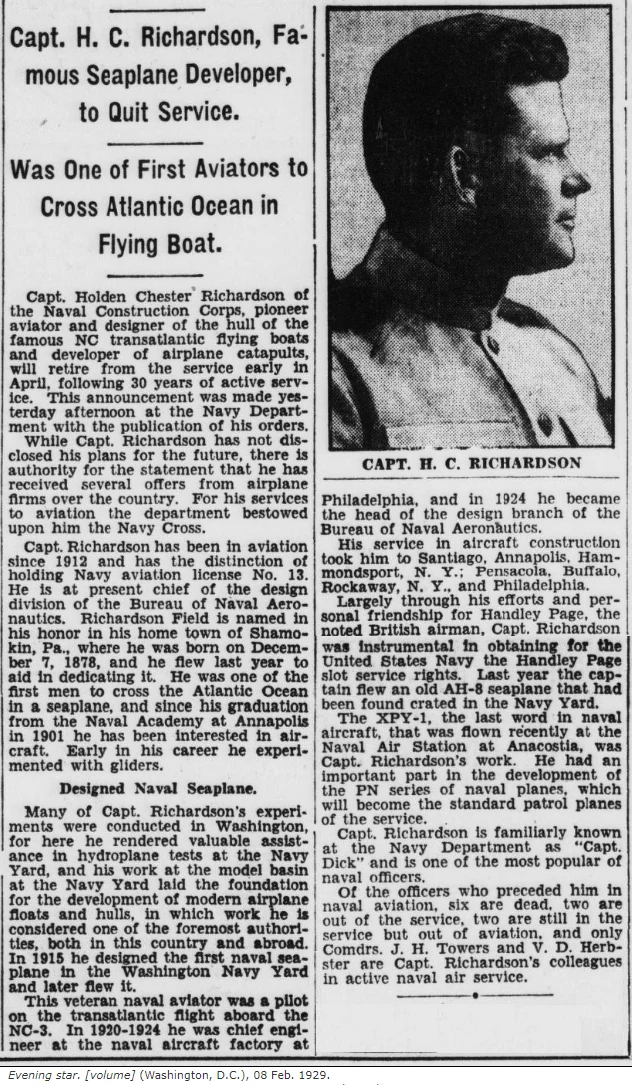
The Evening Star announced in February 1929 that he would retire that spring. Its account surveyed a career of model-basin experiments, aircraft construction, and design work, and described an officer known to colleagues as “Capt. Dick.” It was a contemporary farewell to an active-service career, not the end of Richardson's contribution.
He retired in 1929 and returned to active duty in 1934. He headed the Aerodynamics Laboratory at Carderock from 1942 to 1944 and was released from active duty in 1952. His technical writing included Aircraft Float Design and, with Wellwood E. Beall and Charles W. Manly, Flying Boats.
Remembered at home and beyond
Richardson Field preserved a local link to a career made elsewhere. The 1929 newspaper account expressly connected the field's name and dedication with Shamokin, his birthplace. His achievements later earned national recognition: the National Aviation Hall of Fame enshrined him in 1978.
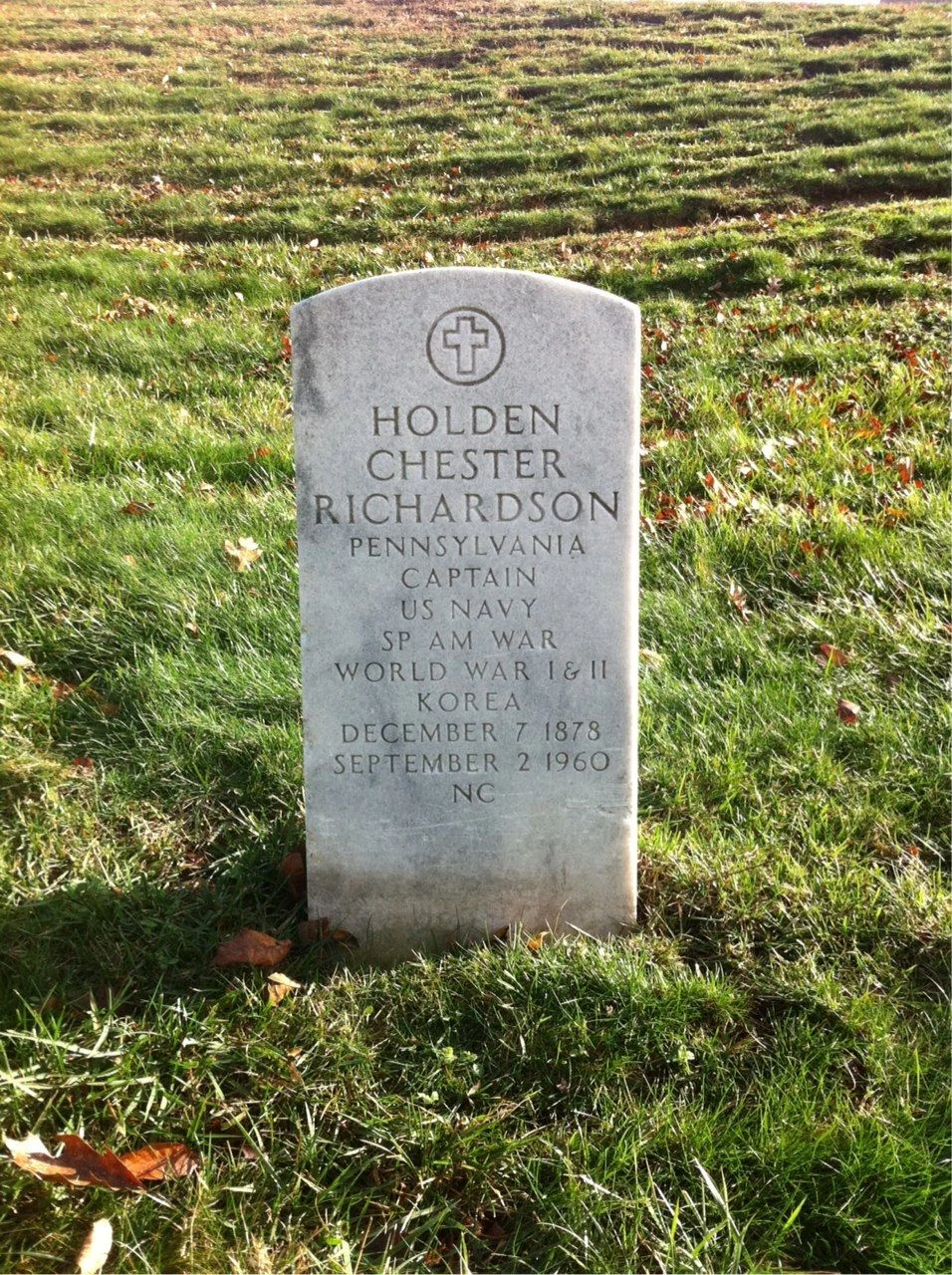
Richardson died in Bethesda, Maryland, on September 2, 1960, and is buried at Arlington National Cemetery. His headstone names a Pennsylvania captain whose lifetime spanned a remarkable transformation in flight. The enduring thread is the engineer's task: making an ambitious idea work in the world outside the drawing board.
A short timeline
- Born in Shamokin on December 7.
- Graduated from the Naval Academy.
- Earned his master's degree at MIT.
- Became NACA's first secretary; formally designated a naval aviator.
- Test-flew NC-1.
- Piloted NC-3 during the Atlantic expedition.
- Retired from the Navy.
- Recalled to active duty.
- Released from active duty.
- Died on September 2.
- Enshrined in the National Aviation Hall of Fame.
Archival film
Watch: The Great Flight
The Department of Defense’s 1970 film revisits the Navy’s 1919 expedition and NC-4’s completed Atlantic crossing. Richardson flew aboard NC-3; the film tells the wider story, not only his biography.
The external player remains off until you choose to load it. Loading the film connects your browser to Internet Archive.
Profile
- Name
- Holden C. Richardson
- Born
- December 7, 1878
- Died
- September 2, 1960
- Place
- Born in Shamokin, Pennsylvania
- Occupation
- Naval constructor and aviatorReported
- Education
- Shamokin High SchoolReported
- Education
- United States Naval AcademyReported
- Military service
- United States Navy captainReported