Historic Business
Eagle Run Brewery
Eagle Run and Fuhrmann & Schmidt’s picture books and newspaper publicity show a brewery business built around brewing, cold storage, bottling, workers, and regional deliveries.

Historic business art
Related historic advertisement
Advertisements connected to this story or place.
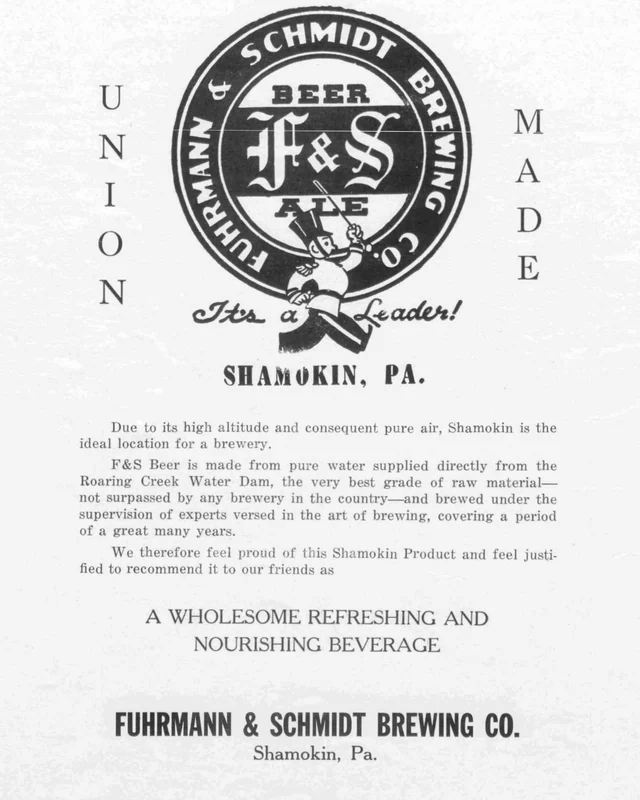
Industrial advertisement
Fuhrmann & Schmidt Brewing Company, 1939
This 1939 industrial advertisement promotes Fuhrmann & Schmidt’s F&S beer and ale in Shamokin. Product-quality language remains period advertising rather than an independent editorial claim.
Eagle Run and Fuhrmann & Schmidt
Eagle Run was a brewery name closely associated with Shamokin. A brewery-sponsored picture book published in 1908 looked back to a small operation producing ale and porter and named Gottlieb Fritz in that early story. By the time the book appeared, the enterprise was presented as the Fuhrmann & Schmidt Brewing Company.
The later centennial history recorded P. H. Fuhrmann and Max Schmidt’s purchase of the brewery in 1895. Their names became part of the identity seen in the company’s photographs, buildings, and advertising. In 1939, its newspaper profile explained that “Fuhrmann and Schmidt” had been shortened in everyday use to F&S.
Inside the Business in 1908
The 1908 picture book presented brewing as a connected industrial operation. It described machinery, vats, storage rooms for maturing beer, an ice plant, and delivery work. Sanitation and mountain water were prominent selling points. The booklet’s praise belonged to the company’s effort to present both its products and Shamokin to a wider public.
The same account claimed at least sixty direct employees, with additional work for agents and for carpenters, painters, saddlers, wheelwrights, and blacksmiths in Shamokin and Coal Township. It described more than sixty horses and mules used for delivery and eleven houses for workers. These were figures offered by the brewery’s own publicity, but they explain the scale of the enterprise it wished readers to imagine: not just a brewhouse, but transport, maintenance, housing, and local trades.
Its operations occupied more than one place. The main Eagle Run plant was separate from the city bottling establishment at Washington and Commerce Streets. Captioned photographs recorded a brew-house addition in 1896, a cold-storage addition in 1900, and a horse-drawn delivery team. Bottling brought the product into containers intended for families and hotel tables, while the larger plant supplied the beer.
Photographs of branches in Mount Carmel, Girardville, Williamsport, Carlisle, Gettysburg, and Harrisburg gave the company’s regional reach a place in the picture book. Their inclusion presented the Shamokin brewery as the center of a network extending well beyond its home town.
The East End Plant in 1939
The Shamokin News-Dispatch’s August 31, 1939 promotional profile offered the company’s account of a later change in location. It said Fuhrmann & Schmidt had acquired the former Shamokin Brewing Company property in the East End and transferred production there after a 1916 fire destroyed the brewing plant at Weigh Scales. The profile also gave 1906 as the year the company was incorporated. These dates form part of the history the brewery was telling about itself in 1939.
An exterior photograph showed the East End plant alongside railway tracks. The accompanying article emphasized machinery, washed vats and tanks, cleaning and inspection of returned containers, and recently installed bottling equipment. It claimed a bottling capacity of 7,286 bottles an hour. The technical detail supported a central advertising message: the company wanted its beer associated with modern equipment and carefully controlled production.
The large advertisement below the article made that message personal. Its portraits included P. H. Fuhrmann, identified as co-founder and president; company officers; the brewmaster and assistant brewmaster; the chief engineer; and bottling, shipping, and platform foremen. A second group pictured local distributors. Under the heading “These are the folks you know,” the company joined an industrial product to recognizable faces.
Fuhrmann & Schmidt also promoted the brewery’s place in the local economy. It said it purchased anthracite and other goods locally, employed a largely steady workforce, and helped local dollars circulate through wages and employee purchases. Claims about superior pay, paid vacations, taxes, and unionization were part of that presentation. The advertisement asked readers to think of the brewery’s importance through the work and spending connected to it.
F&S beer and ale appeared as Shamokin products in the town’s 1939 Diamond Jubilee advertising as well. Across the picture book, newspaper page, and jubilee booklet, the company repeatedly placed itself within the community’s public story: a local name, an industrial employer, and a product carried to customers by a network of workers and distributors.